Are We Growing Apart or Just Going Through a Hard Season?
Key Takeaways
Distance doesn't always mean your relationship is ending.
Hard seasons can create real disconnection.
Growing together takes intentionality.
Notice the pattern before deciding what it means.
Oh boy, do we all like certainty. Especially me!
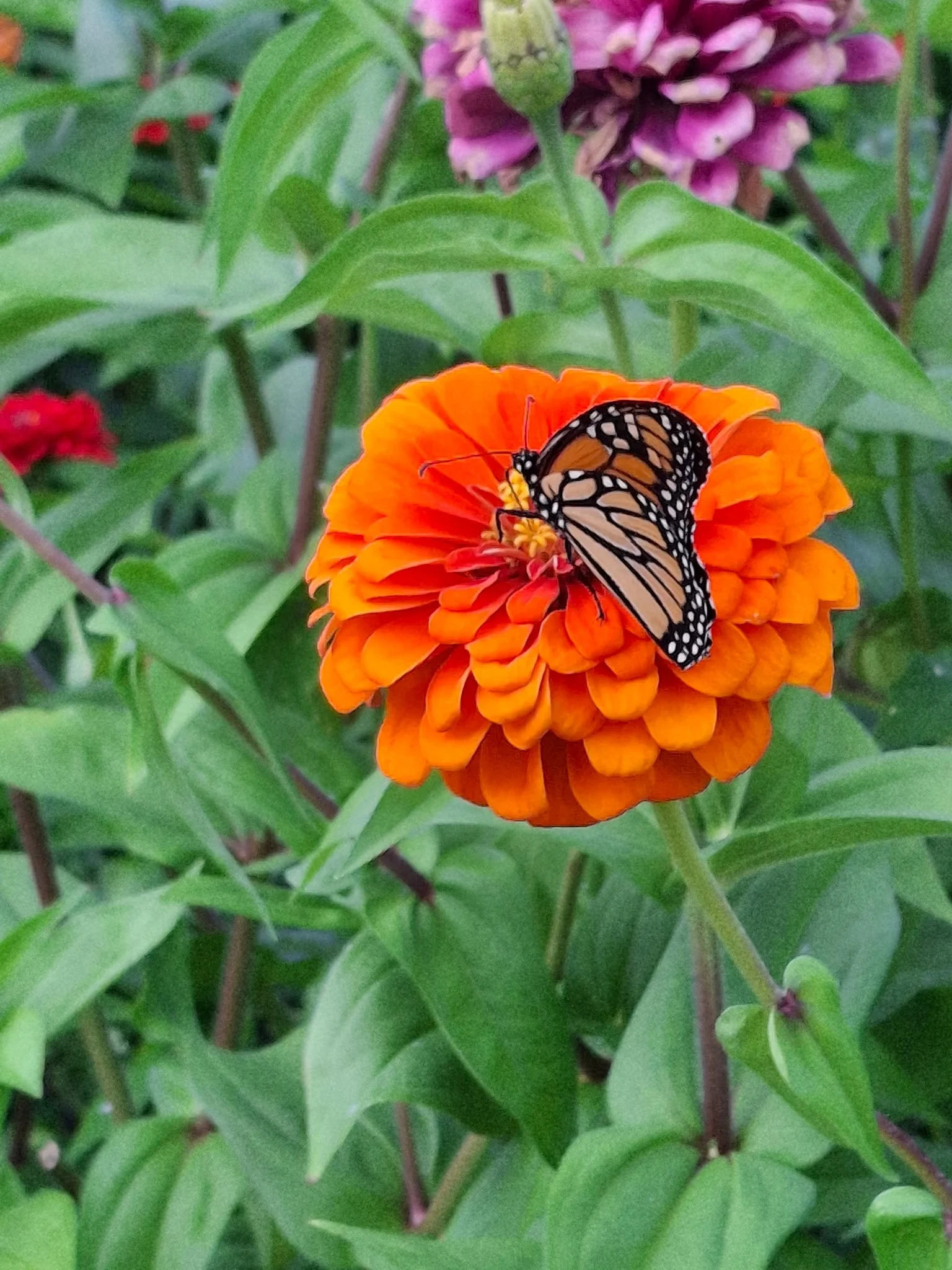
This is one of my plants that survived the crazy heat this summer. Even the butterfly is showing it some love while getting nourishment from the flower. Talk about a symbiotic relationship!
Sitting with the not knowing can be really uncomfortable. What did they mean by that? What does that look mean? Are we growing apart? Is something wrong with our relationship? Are we doomed?
And before you know it, your brain has gone down a very scary rabbit hole with all kinds of gnarly roots where you get snagged on every little detail. They didn't kiss me goodbye this morning. We haven't had sex as much lately. They seemed annoyed when I asked that question. We had another argument last night. I don't feel as excited to see them as I used to.
Suddenly, every look, tone, argument, or lack of connection starts feeling like evidence that something is terribly wrong.
Sometimes we need to zoom out. Not because those things don't matter. They do. But because relationships are living, growing, breathing things. And just like most living things, they go through seasons.
Relationships Have Seasons
I love gardening. Every spring, I get excited about starting my seeds inside. March and April in Massachusetts are a mixed bag weather-wise, so everything starts indoors where I can keep an eye on it. And I do keep an eye on it. I check the soil. I water. I watch for those first tiny signs of green poking through the dirt. Seeing that first little bit of growth and promise is exciting.
Eventually, it's time to move my seedlings outside. At first, they need a lot of attention. I have to water them more frequently and protect them from the intense sun and wind while they're getting established. They're not quite strong enough yet to withstand all of the ebbs and flows of the weather on their own.
Relationships can feel a little like this in the beginning. Everything is new. You're curious about each other. You want to spend time together. You talk for hours. You laugh. You have fun. Sex is more exciting and maybe more frequent,. You ask questions. You're learning about this other person, and they're learning about you. The soil is rich and nourishing, and you're paying a lot of attention to what's growing.
But eventually, the relationship becomes more established. And that's not a bad thing. In fact, it's supposed to happen.
Established Doesn't Mean Self-Sustaining
By the middle of the gardening season, things are usually growing pretty well. And this is also when I get a little...less attentive. I can take a breath and attend to other things that are pulling for my attention.
It's hot. I'm busy. There are a million other things happening. Somewhere in the back of my mind I'm thinking, I really need to water those plants.
Sometimes I remember. Sometimes I don't.
Eventually, the plants let me know. They wilt. Then I'm outside with the hose doing some last-minute watering, crossing my fingers and hoping they perk back up. Most of the time, they do.
Wilting doesn't necessarily mean dying.
I think this is important in relationships, too. As relationships mature, the amount of attention we naturally gave each other in the beginning isn't always sustainable. Life seeps in. Jobs, children, financial stress, moves, cars breaking down, promotions, job losses, the birth of a child, illness, aging parents, grief, retirement planning, kids leaving home, hormonal changes, and just plain exhaustion all compete for our attention.
Sometimes the relationship that once received so much of our attention quietly moves further down the list. That doesn't necessarily mean you don't love each other anymore. But it might mean your relationship needs some water, maybe a little compost, and gentle sunshine.
What If the Answer Is...Yes and Yes?
So, are you growing apart? Or are you just going through a hard season?
I think sometimes the answer is yes and yes.
Those two things aren't necessarily opposites. Sometimes we grow apart during hard seasons. Maybe you've spent the last few years raising small children, and most of your conversations are about logistics. Maybe one of you has been consumed by work. Maybe you've experienced a loss. Maybe you're caring for aging parents. Maybe you've been dealing with financial stress. Maybe the kids have left home, and suddenly you're looking across the room at each other thinking, Okay...who are we now?
You may have become a little disconnected or a lot disconnected while you were busy surviving life. That doesn't necessarily tell us what happens next.
The more important question may be: What happens now that you're noticing it?
Don't Decide What the Distance Means Before You Understand It
This is where I think our desire for certainty can get us into trouble. We notice distance and immediately try to explain it. We're not having sex as often, so my partner must not be attracted to me anymore. We don't talk like we used to, so maybe we've grown apart. My partner doesn't seem interested in spending time together, so maybe they don't care.
But there may be information you're missing. Maybe your partner is barely keeping their head above water. Maybe they're exhausted. Maybe they've been feeling disconnected too. Maybe there's resentment that hasn't been talked about. Maybe they miss you but don't know how to reach for you anymore. Maybe you've both been waiting for the other person to make the first move.
Before deciding what the distance means, get curious about what's happening around it. Zoom out. What has been happening in your lives? When did you begin feeling this way? What changed? How long has it been going on? And perhaps most importantly: How is your partner experiencing the relationship right now?
There is also something else that can happen when we start worrying about our relationship. The fear itself can begin shaping how we interact with our partner. If I'm afraid we're growing apart, I may start looking for reassurance that we're okay. I might bring up the relationship more often, ask more questions, or become especially aware of every time you don't reach for me. From my perspective, I'm trying to bring us closer.
But you might experience me as putting pressure on you.
Your response to that pressure might be to pull back, avoid another conversation about the relationship, or quickly tell me "We're fine" because you don't know what else to say. I experience your pulling away as more evidence that something is wrong, so I reach harder. You feel more pressure, so you pull away more.
Before long, we're not only dealing with the original disconnection. We're also dealing with the pattern we've created trying to cope with the disconnection.
This is one of the patterns I often help couples slow down and understand in Couples Therapy Worcester, MA. Instead of asking, "Which one of us is causing this?" we can become curious about "What happens between us when we start feeling disconnected?" What does each person do to protect themselves, and how might those protective responses unintentionally make it harder to find each other?
You May Not Be Experiencing the Same Season
This is something I see often in my work with couples. One partner may be thinking, We're busy, but we're okay. Meanwhile, the other is thinking, I haven't felt close to you in two years.
One person may genuinely have no idea how unhappy or disconnected their partner has been feeling. We can’t assume we know our partner's experience simply because we've been together for a long time.
When was the last time you asked your partner how the relationship actually feels to them? Not, "We're good, right?" "Yep." "Cool." I mean really asking.
What feels good between us right now? When do you feel connected to me? Where do you think we've gotten off track? Is there anything you've been missing from us? What would you like more of in our relationship? Is there something I've been doing or not doing that has made it harder for you to feel connected to me or makes you feel more connected?
You may be surprised by what you hear.
What Does Distance Mean to You?
Distance doesn't mean the same thing to everyone.
This is where I think our histories matter. What did closeness look like in the family you grew up in? Did people talk about their feelings? Did everyone spend a lot of time together? Was affection common? Were people expected to handle things on their own? What happened when someone was upset? Did people move toward each other, or did everyone retreat to their own corners?
Maybe distance feels particularly scary to you because, growing up, distance meant someone was angry, something was wrong, or love might be taken away. Or maybe space feels completely normal to you because independence was valued in your family and people didn't need a lot of emotional checking in to feel connected.
Now put two people with different experiences of closeness in the same relationship.
One person may think, "If we're okay, why don't you want to spend more time with me?" The other may genuinely be thinking, "Of course we're okay. If something were wrong, I'd tell you."
Neither person's experience is necessarily wrong. But if we don't understand what closeness and distance mean to each of us, we can start assigning meaning to our partner's behavior that they never intended.
Sometimes we're not only reacting to what is happening right now. We're also reacting to everything: closeness, distance, conflict, and connection have come to mean to us over a lifetime. Understanding those histories and the patterns they create is an important part of the work I help couples with at Couples Therapy Massachusetts.
Growing Together Doesn't Just Happen
I think there's sometimes an assumption that if two people love each other enough, they'll naturally continue growing together. That's not how relationships work.
Growing together takes intentionality.
That doesn't mean obsessing over every misstep, argument, look, or tone. Relationships don't need to be examined under a microscope every day. But they probably shouldn't be left on autopilot for years either.
It might mean occasionally taking the temperature of your relationship. How are we doing? What's working? What's not? What do we both want? Are the compromises we made six months ago still working for both of us? Do our shared goals still make sense?
It also means coming back together after conflict rather than having a huge argument on Tuesday and pretending nothing happened on Wednesday. What happened between us? What did that bring up for you? What did I miss? What could we do differently next time?
These conversations don't come naturally to every couple. But they can help you notice when your relationship needs attention before everything becomes...well...crunchy.
And Then There Are My Crunchy Plants
Toward the end of summer, the novelty of gardening has definitely worn off for me. And this is where things can get a bit ugly.
There are plants I've neglected to the point where they're crunchy. I see them. I know they're there. And sometimes I guiltily avoid looking at them as though not looking is somehow going to change the result.
Spoiler alert: it does not.
I think couples sometimes do this too. We know something isn't quite right. We haven't had sex in months. We barely talk anymore. We're irritated with each other all the time. We haven't spent meaningful time alone together in forever. We feel more like roommates, coworkers, or co-parents than partners.
But looking at the relationship can feel scary because once we acknowledge that something isn't working, we may feel like we have to do something about it. So sometimes we avoid it.
But avoiding the crunchy plant doesn't make it less crunchy. And avoiding disconnection usually doesn't create connection.
Attention Doesn't Mean Panic
I want to make an important distinction here. Paying attention to your relationship doesn't mean fretting over it.
Not every argument means you're incompatible. Not every disconnected week means you're growing apart. Not every season of less sex means your relationship is in trouble. Not every moment when you don't particularly like your partner means you've fallen out of love.
Sometimes you're tired. Sometimes life is hard. Sometimes your partner is driving you nuts. You're two imperfect humans trying to build a life together.
The goal isn't to keep your relationship in some permanent state of bloom. That's not how gardens work, and I don't think that's how relationships work either.
The goal is to notice. To pay enough attention that when something starts wilting, you get curious about what it needs.
What Does Your Relationship Need in This Season?
Maybe your relationship doesn't need what it needed five years ago. Maybe you don't need what you needed five years ago. Neither does your partner.
That's another reason relationships can't simply run on autopilot. You're both still changing. The person sitting across from you isn't exactly the same person you married 10 or 20 years ago. And neither are you.
Maybe this season requires more time together. Maybe it requires more independence. Maybe you need more affection, play, sex, conversation, help around the house, appreciation, honesty, or rest. Maybe you need to grieve something together. Maybe you need to renegotiate roles that worked when your children were little but don't make sense anymore. Maybe you simply need to become curious about each other again.
And don't assume what each of you needs in this season will be the same.
One partner may need more closeness while the other needs some breathing room. One may want to talk through what's happening while the other needs time to figure out what they're even feeling. One may desperately want a date night while the other is thinking, I don't need another thing on my calendar. I need to sleep.
This is where couples can accidentally turn different needs into evidence that something is wrong.
"If you loved me, you'd want to spend time with me."
"If you understood how overwhelmed I am, you wouldn't ask me for more right now."
And suddenly you're fighting about the solution instead of trying to understand the experience underneath it.
Sometimes tending to a relationship means figuring out how to hold both people's needs rather than deciding whose need is more legitimate. What would connection look like that doesn't overwhelm one partner? What would space look like that doesn't leave the other feeling alone? Where is there room for compromise? And does that compromise still work for both of you a few months from now?
You don't have to know the answer before you begin the conversation. You just have to be willing to look at what's growing and what isn't.
When Couples Therapy Can Help
Sometimes couples know their relationship needs attention but can't quite figure out what's happening between them. One person may be trying desperately to reconnect while the other feels pressured. One may see a hard season while the other sees a relationship in trouble. Both may be protecting themselves in ways that make perfect sense individually but create even more distance between them.
That's often where Marriage Counseling Worcester can help.
Therapy creates a place to slow things down enough to see the pattern without turning the conversation into "This is your fault" or "You're the reason we're here." Instead, we can begin exploring: How did we get here? What has this season been like for each of you? What happens when one of you reaches and the other pulls away? What are you each protecting? What are you each longing for? And where would you like to go from here?
Sometimes the work isn't about teaching a couple how to communicate better in some generic way. It's helping them understand why the way they're communicating makes so much sense given who they are, what they've experienced, and what they're trying to protect, and then figuring out whether those old ways of coping are still helping them create the relationship they want today.
Then we can start looking at the soil. What's depleted? What's been neglected? What needs pruning? What needs more nourishment? And what is already growing that you want to protect?
Your Relationship Doesn't Have to Be in Bloom All the Time
Maybe your relationship doesn't need to become what it was in the spring. Maybe that's not even possible.
You've both changed. Life has happened. There is more history between you now, the beautiful parts and the painful ones.
But that doesn't mean nothing can grow here.
Sometimes you need to look at the soil, pull some weeds, add some nutrients, water what's been neglected, and get curious about what your relationship needs in this particular season.
You may be going through a hard season. You may have grown apart during it. And noticing that doesn't mean you're doomed.
It may simply mean it's time to tend to the relationship again.
Because relationships don't have to stay in bloom all the time to still be alive.
Frequently Asked Questions
Is it normal for couples to feel like they're growing apart?
Yes. Long-term relationships naturally change, and periods of distance can happen during stressful or transitional seasons. Feeling disconnected doesn't automatically mean the relationship is ending. It may be a signal that something in the relationship needs attention.
How do I know if we're growing apart or just going through a hard time?
Zoom out and look at what else is happening in your lives. Stress, parenting, grief, work, health concerns, financial pressure, caregiving, or major life transitions can all affect connection. Also consider how long the distance has been present and whether both partners are willing to talk about what is happening and tend to the relationship.
Can you still love someone and feel disconnected from them?
Absolutely. Love and connection aren't exactly the same thing. You can deeply love your partner while also feeling lonely, distant, frustrated, or unsure of how to reach each other.
Can stress make couples feel like they're falling out of love?
Stress can significantly change how much emotional and physical energy partners have available for each other. Sometimes a decrease in connection or capacity gets interpreted as a decrease in love. Understanding what else is happening in your lives can help you distinguish between the two.
What are signs that our relationship needs more attention?
Feeling more like roommates than partners, rarely spending meaningful time together, avoiding important conversations, ongoing resentment, decreased affection or intimacy, and repeatedly feeling lonely in the relationship can all be signs that it's worth slowing down and becoming curious about what's happening.
What if one of us thinks we're fine and the other thinks we're growing apart?
This is more common than you might think. Partners can experience the exact same relationship very differently. Rather than deciding whose interpretation is correct, make space for both experiences and get curious about what connection, closeness, and distance mean to each of you.
How can we reconnect when we've grown apart?
Start small. Talk about what you've each been experiencing without immediately trying to determine who is responsible. Ask what your partner has been missing and share what you've been longing for. Reconnection might include more intentional time together, affection, play, conversation, intimacy, shared experiences, or simply becoming curious about each other again.
When should we consider couples therapy?
You don't have to wait until your relationship is in crisis. If you've noticed ongoing distance, keep having the same conversations without getting anywhere, or aren't sure how to talk about what's happening without blame or defensiveness, Couples Therapy Worcester, MA can provide a space to understand the pattern and explore what each of you needs moving forward.
Further Reading
If this topic resonates with you, you may also find these articles helpful:
How Family-of-Origin Patterns Show Up in Your Relationship And What to Do About It — Explore how the families we grow up in shape what closeness, conflict, communication, and connection mean to us.
Why Stress Steals Connection in Relationships — A closer look at how overwhelm and survival mode can affect the way partners respond to and connect with each other.
Why Repair Matters More Than the Fight — Learn why conflict itself isn't necessarily the problem and how coming back together after disconnection can strengthen a relationship.
Emotional Safety: The Quiet Foundation of a Healthy Relationship — Explore what emotional safety looks and feels like and why it matters when partners are trying to reconnect.

I am a trauma-informed individual and couples therapist trained in family systems-based couples therapy. I pull from a variety of frameworks, including Narrative Therapy, ACT, and Imago, just to name a few. My approach is authentic, down to earth, and infused with humor. My work with couples is rooted in the belief that relationships are both incredible and super hard, and that we’re not meant to navigate them alone.
I help couples develop empathy for themselves and each other while exploring how their personal histories and patterns shape the dynamics they bring into the relationship. Together, we create space for insight, healing, and growth so partners can learn new ways of engaging with one another, ones that reflect how they truly want to show up in their relationship.
Specialties: Couples Therapy, Individual Therapy for Anxiety, Burnout and Relationship Support.
